Standardizing an absence tracking system
Impact: First in-store research conducted for this HR platform, directly shaping product requirements.
Methods: qualitative research, interviewing, affinity mapping, process mapping, workshop facilitation
Timeline: 2 months


Certain details of this case study have been modified to protect proprietary information.
Background
At a national grocery retailer, employees calling into stores to report they won’t be able to work was a demanding process. Employees were making multiple calls to stores trying to reach managers and sometimes going through customer service to reach them. Managers had to go through a multi-step process to find a replacement. The impact of having an unfilled shift can cause stress on the store and create a potential negative customer experience. Beyond operational pains, there wasn’t any standardization around how employee absences were documented.
At a national grocery retailer, employees calling into stores to report they won’t be able to work was a demanding process. Employees were making multiple calls to stores trying to reach managers and sometimes going through customer service to reach them. Managers had to go through a multi-step process to find a replacement.
The impact of having an unfilled shift can cause stress on the store and create a potential negative customer experience. Beyond operational pains, there wasn’t any standardization around how employee absences were documented.
Goal
Take a manual call-in process and add those capabilities to an HR platform, standardizing the process for both employees and managers filling shifts.
My contributions
I worked in partnership with the Design Lead on the team. I led the research and also contributed to the early product definition and workflow design.
Advocated for in-store research before project kickoff workshops took place.
Lead research efforts in creating interview guides and synthesizing findings in Dovetail and presenting to the business.
Translated research insights into workflow requirements.
Developed current state and future state process flows, helping identify and address risks and gaps.
Defined interaction requirements needed for shift call out and replacement workflows.
I worked in partnership with the Design Lead on the team. I led the research and also contributed to the early product definition and workflow design.
Advocated for in-store research before project kickoff workshops took place.
Lead research efforts in creating interview guides and synthesizing findings in Dovetail and presenting to the business.
Translated research insights into workflow requirements.
Developed current state and future state process flows, helping identify and address risks and gaps.
Defined interaction requirements needed for shift call out and replacement workflows.
What research uncovered
I visited local grocery stores and interviewed a total of 11 employees and managers. One finding that impacted the design was that in order for a manager to fill a shift it wasn't as simple as picking any employee. There were many factors that needed to be considered such as employees with the right skillset or considering some roles have specific contracts tied to them. Finding out this information early meant that it could be addressed early during requirements gathering and weaving this into the chatbot’s design.
I visited local grocery stores and interviewed a total of 11 employees and managers. One finding that impacted the design was that in order for a manager to fill a shift it wasn't as simple as picking any employee.
There were many factors that needed to be considered such as employees with the right skillset or considering some roles have specific contracts tied to them. Finding out this information early meant that it could be addressed early during requirements gathering and weaving this into the chatbot’s design.


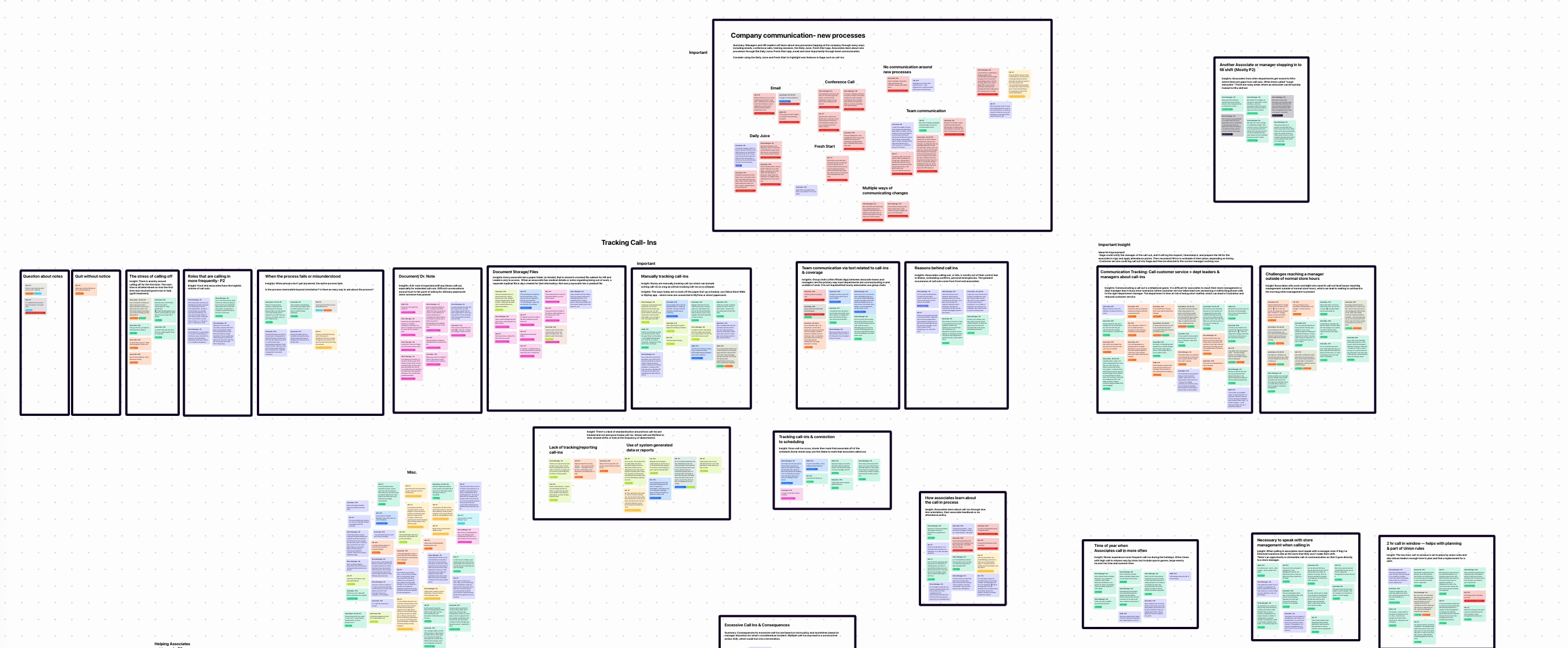
Affinity map of the data in Dovetail from the interviews.
Creating alignment across teams
Our business partners had a general sense of the call-in experience, but the research our team did, uncovered nuances and details that they hadn’t considered.
To translate a manual process into a digital format, I created a current state journey map and a future state journey map to show what new processes needed to take place. I walked the business and the development team through both maps, and showed where I found gaps in the new process and segments in the process that needed input. This brought clarity for product requirements and reduced risk of missing processes during the development stage.
Our business partners had a general sense of the call-in experience, but the research our team did, uncovered nuances and details that they hadn’t considered.
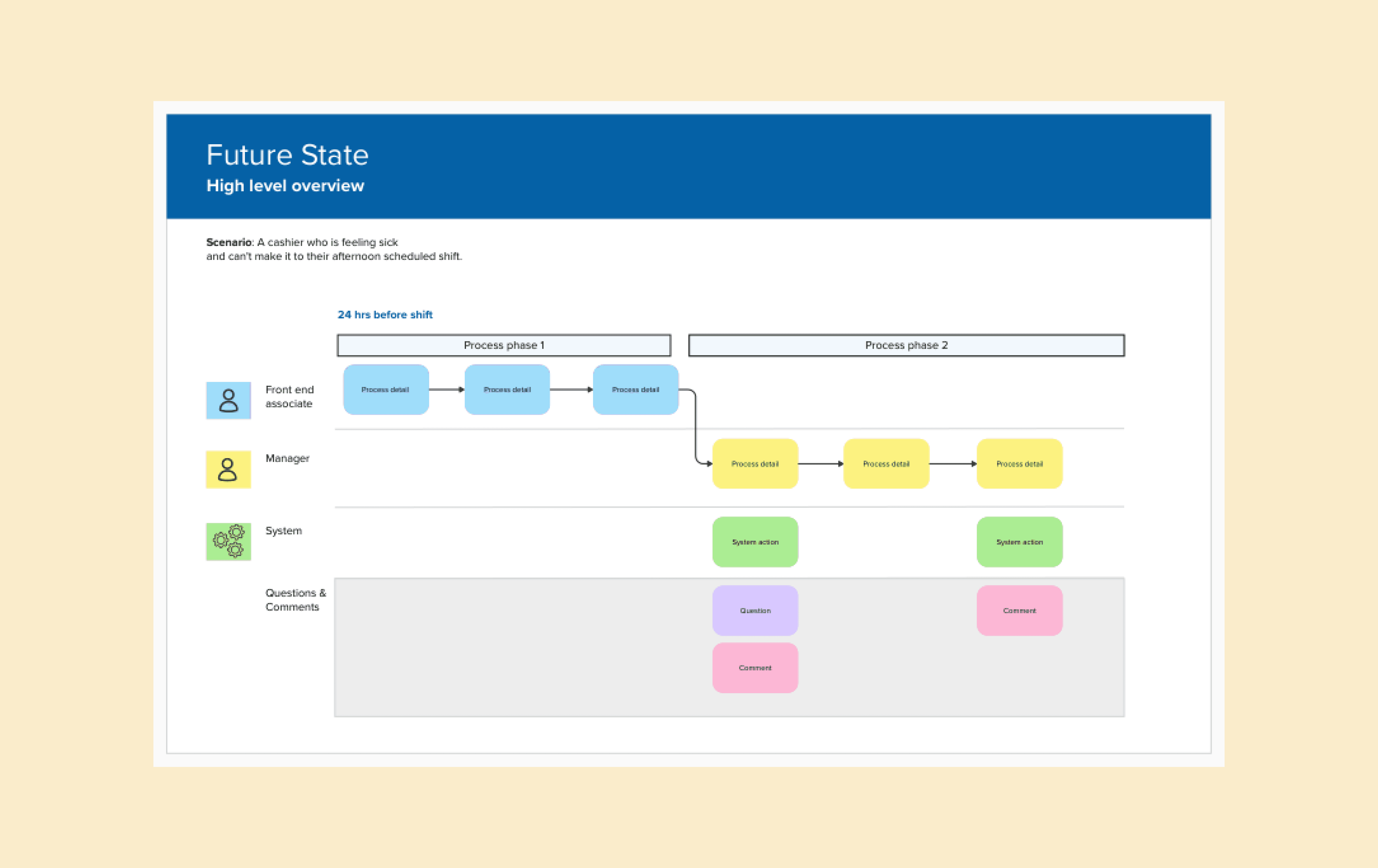
To translate a manual process into a digital format, I created a current state journey map and a future state journey map to show what new processes needed to take place.
I walked the business and the development team through both maps, and showed where I found gaps in the new process and segments in the process that needed input. This brought clarity for product requirements and reduced risk of missing processes during the development stage.

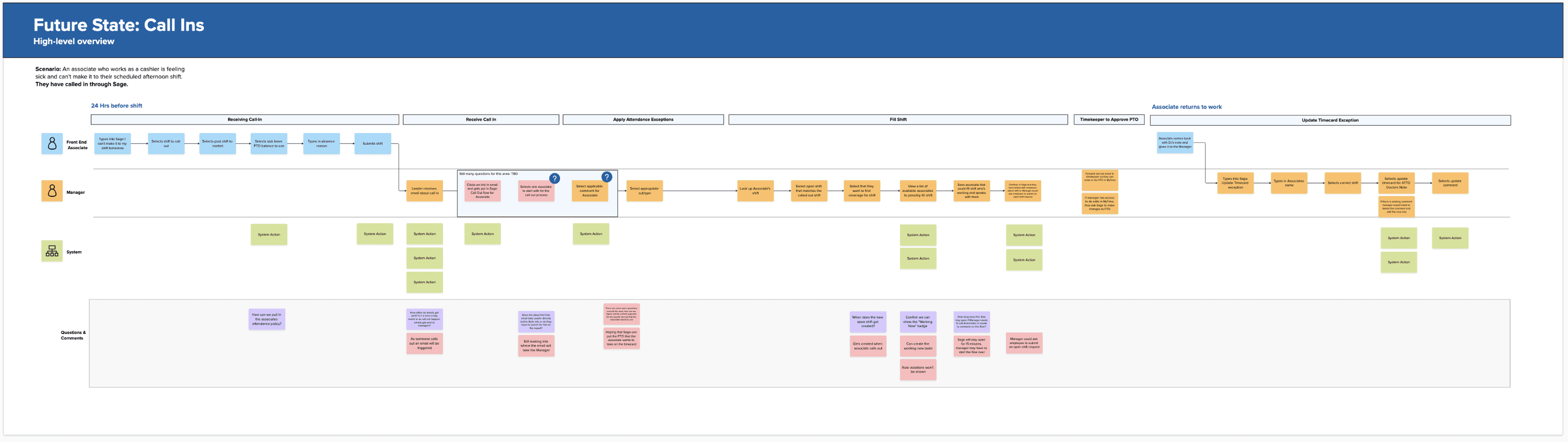
Overview of the future-state journey map for call-ins.
Using the future state journey map and the detailed processes and requirements from the workshops, I crafted decision trees that the chatbot would need to cover when employees call in and can’t make their shift. These processes could then be used by the team to create the high-fidelity UI.
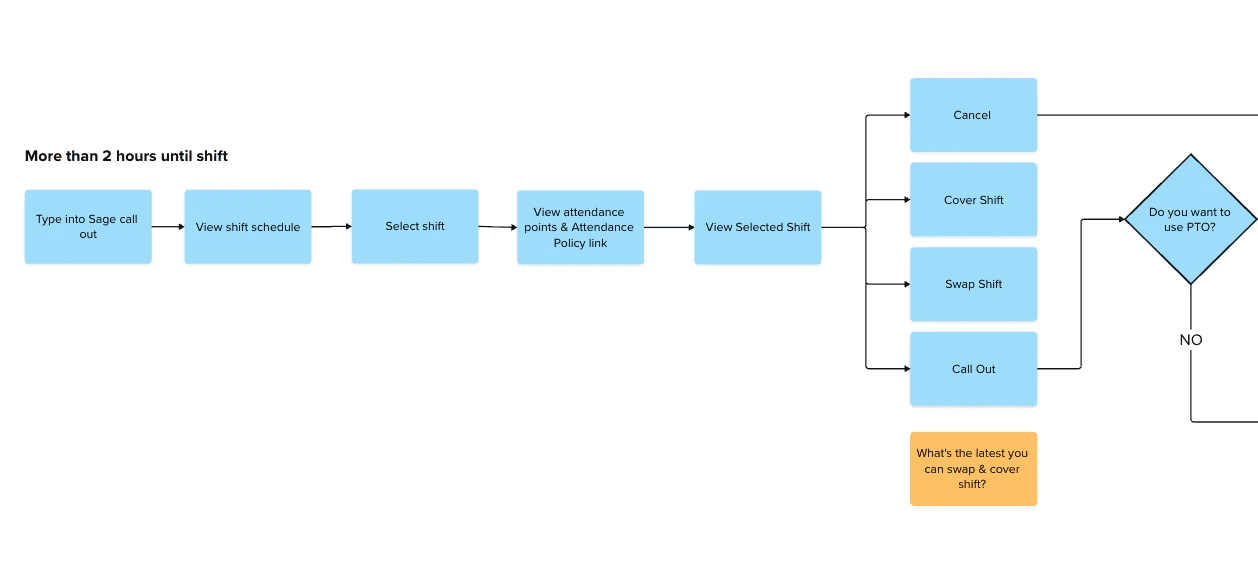

Process for an employee calling in with the new system.
Outcomes
This was the first time in-store research had been able to be conducted for the HR chatbot product. Conducting research before the project kick-off workshops gave the team insights to additional business requirements that were needed. Aligning with the business on research and future state findings was critical in developing the right product and saving rework time.
If I had more time on the project, I would want to understand employee sentiment around the new call-in process, time savings for managers filling a shift and understand if the new system has created consistency around call in documentation.
Other works
Standardizing an absence tracking system
Impact: First in-store research conducted for this HR platform, directly shaping product requirements.
Methods: qualitative research, interviewing, affinity mapping, process mapping, workshop facilitation
Timeline: 2 months


Certain details of this case study have been modified to protect proprietary information.
Background
At a national grocery retailer, employees calling into stores to report they won’t be able to work was a demanding process. Employees were making multiple calls to stores trying to reach managers and sometimes going through customer service to reach them. Managers had to go through a multi-step process to find a replacement. The impact of having an unfilled shift can cause stress on the store and create a potential negative customer experience. Beyond operational pains, there wasn’t any standardization around how employee absences were documented.
At a national grocery retailer, employees calling into stores to report they won’t be able to work was a demanding process. Employees were making multiple calls to stores trying to reach managers and sometimes going through customer service to reach them. Managers had to go through a multi-step process to find a replacement.
The impact of having an unfilled shift can cause stress on the store and create a potential negative customer experience. Beyond operational pains, there wasn’t any standardization around how employee absences were documented.
Goal
Take a manual call-in process and add those capabilities to an HR platform, standardizing the process for both employees and managers filling shifts.
My contributions
I worked in partnership with the Design Lead on the team. I led the research and also contributed to the early product definition and workflow design.
Advocated for in-store research before project kickoff workshops took place.
Lead research efforts in creating interview guides and synthesizing findings in Dovetail and presenting to the business.
Translated research insights into workflow requirements.
Developed current state and future state process flows, helping identify and address risks and gaps.
Defined interaction requirements needed for shift call out and replacement workflows.
I worked in partnership with the Design Lead on the team. I led the research and also contributed to the early product definition and workflow design.
Advocated for in-store research before project kickoff workshops took place.
Lead research efforts in creating interview guides and synthesizing findings in Dovetail and presenting to the business.
Translated research insights into workflow requirements.
Developed current state and future state process flows, helping identify and address risks and gaps.
Defined interaction requirements needed for shift call out and replacement workflows.
What research uncovered
I visited local grocery stores and interviewed a total of 11 employees and managers. One finding that impacted the design was that in order for a manager to fill a shift it wasn't as simple as picking any employee. There were many factors that needed to be considered such as employees with the right skillset or considering some roles have specific contracts tied to them. Finding out this information early meant that it could be addressed early during requirements gathering and weaving this into the chatbot’s design.
I visited local grocery stores and interviewed a total of 11 employees and managers. One finding that impacted the design was that in order for a manager to fill a shift it wasn't as simple as picking any employee.
There were many factors that needed to be considered such as employees with the right skillset or considering some roles have specific contracts tied to them. Finding out this information early meant that it could be addressed early during requirements gathering and weaving this into the chatbot’s design.


Affinity map of the data in Dovetail from the interviews.
Creating alignment across teams
Our business partners had a general sense of the call-in experience, but the research our team did, uncovered nuances and details that they hadn’t considered.
To translate a manual process into a digital format, I created a current state journey map and a future state journey map to show what new processes needed to take place. I walked the business and the development team through both maps, and showed where I found gaps in the new process and segments in the process that needed input. This brought clarity for product requirements and reduced risk of missing processes during the development stage.
Our business partners had a general sense of the call-in experience, but the research our team did, uncovered nuances and details that they hadn’t considered.
To translate a manual process into a digital format, I created a current state journey map and a future state journey map to show what new processes needed to take place.
I walked the business and the development team through both maps, and showed where I found gaps in the new process and segments in the process that needed input. This brought clarity for product requirements and reduced risk of missing processes during the development stage.

Overview of the future-state journey map for call-ins.
Using the future state journey map and the detailed processes and requirements from the workshops, I crafted decision trees that the chatbot would need to cover when employees call in and can’t make their shift. These processes could then be used by the team to create the high-fidelity UI.


Process for an employee calling in with the new system.
Outcomes
This was the first time in-store research had been able to be conducted for the HR chatbot product. Conducting research before the project kick-off workshops gave the team insights to additional business requirements that were needed. Aligning with the business on research and future state findings was critical in developing the right product and saving rework time.
If I had more time on the project, I would want to understand employee sentiment around the new call-in process, time savings for managers filling a shift and understand if the new system has created consistency around call in documentation.
Other works
Standardizing an absence tracking system
Impact: First in-store research conducted for this HR platform, directly shaping product requirements.
Methods: qualitative research, interviewing, affinity mapping, process mapping, workshop facilitation
Timeline: 2 months


Certain details of this case study have been modified to protect proprietary information.
Background
At a national grocery retailer, employees calling into stores to report they won’t be able to work was a demanding process. Employees were making multiple calls to stores trying to reach managers and sometimes going through customer service to reach them. Managers had to go through a multi-step process to find a replacement. The impact of having an unfilled shift can cause stress on the store and create a potential negative customer experience. Beyond operational pains, there wasn’t any standardization around how employee absences were documented.
At a national grocery retailer, employees calling into stores to report they won’t be able to work was a demanding process. Employees were making multiple calls to stores trying to reach managers and sometimes going through customer service to reach them. Managers had to go through a multi-step process to find a replacement.
The impact of having an unfilled shift can cause stress on the store and create a potential negative customer experience. Beyond operational pains, there wasn’t any standardization around how employee absences were documented.
Goal
Take a manual call-in process and add those capabilities to an HR platform, standardizing the process for both employees and managers filling shifts.
My contributions
I worked in partnership with the Design Lead on the team. I led the research and also contributed to the early product definition and workflow design.
Advocated for in-store research before project kickoff workshops took place.
Lead research efforts in creating interview guides and synthesizing findings in Dovetail and presenting to the business.
Translated research insights into workflow requirements.
Developed current state and future state process flows, helping identify and address risks and gaps.
Defined interaction requirements needed for shift call out and replacement workflows.
I worked in partnership with the Design Lead on the team. I led the research and also contributed to the early product definition and workflow design.
Advocated for in-store research before project kickoff workshops took place.
Lead research efforts in creating interview guides and synthesizing findings in Dovetail and presenting to the business.
Translated research insights into workflow requirements.
Developed current state and future state process flows, helping identify and address risks and gaps.
Defined interaction requirements needed for shift call out and replacement workflows.
What research uncovered
I visited local grocery stores and interviewed a total of 11 employees and managers. One finding that impacted the design was that in order for a manager to fill a shift it wasn't as simple as picking any employee. There were many factors that needed to be considered such as employees with the right skillset or considering some roles have specific contracts tied to them. Finding out this information early meant that it could be addressed early during requirements gathering and weaving this into the chatbot’s design.
I visited local grocery stores and interviewed a total of 11 employees and managers. One finding that impacted the design was that in order for a manager to fill a shift it wasn't as simple as picking any employee.
There were many factors that needed to be considered such as employees with the right skillset or considering some roles have specific contracts tied to them. Finding out this information early meant that it could be addressed early during requirements gathering and weaving this into the chatbot’s design.


Affinity map of the data in Dovetail from the interviews.
Creating alignment across teams
Our business partners had a general sense of the call-in experience, but the research our team did, uncovered nuances and details that they hadn’t considered.
To translate a manual process into a digital format, I created a current state journey map and a future state journey map to show what new processes needed to take place. I walked the business and the development team through both maps, and showed where I found gaps in the new process and segments in the process that needed input. This brought clarity for product requirements and reduced risk of missing processes during the development stage.
Our business partners had a general sense of the call-in experience, but the research our team did, uncovered nuances and details that they hadn’t considered.
To translate a manual process into a digital format, I created a current state journey map and a future state journey map to show what new processes needed to take place.
I walked the business and the development team through both maps, and showed where I found gaps in the new process and segments in the process that needed input. This brought clarity for product requirements and reduced risk of missing processes during the development stage.

Overview of the future-state journey map for call-ins.
Using the future state journey map and the detailed processes and requirements from the workshops, I crafted decision trees that the chatbot would need to cover when employees call in and can’t make their shift. These processes could then be used by the team to create the high-fidelity UI.


Process for an employee calling in with the new system.
Outcomes
This was the first time in-store research had been able to be conducted for the HR chatbot product. Conducting research before the project kick-off workshops gave the team insights to additional business requirements that were needed. Aligning with the business on research and future state findings was critical in developing the right product and saving rework time.
If I had more time on the project, I would want to understand employee sentiment around the new call-in process, time savings for managers filling a shift and understand if the new system has created consistency around call in documentation.
Other works
Standardizing an absence tracking system
Impact: First in-store research conducted for this HR platform, directly shaping product requirements.
Methods: qualitative research, interviewing, affinity mapping, process mapping, workshop facilitation
Timeline: 2 months


Certain details of this case study have been modified to protect proprietary information.
Background
At a national grocery retailer, employees calling into stores to report they won’t be able to work was a demanding process. Employees were making multiple calls to stores trying to reach managers and sometimes going through customer service to reach them. Managers had to go through a multi-step process to find a replacement. The impact of having an unfilled shift can cause stress on the store and create a potential negative customer experience. Beyond operational pains, there wasn’t any standardization around how employee absences were documented.
At a national grocery retailer, employees calling into stores to report they won’t be able to work was a demanding process. Employees were making multiple calls to stores trying to reach managers and sometimes going through customer service to reach them. Managers had to go through a multi-step process to find a replacement.
The impact of having an unfilled shift can cause stress on the store and create a potential negative customer experience. Beyond operational pains, there wasn’t any standardization around how employee absences were documented.
Goal
Take a manual call-in process and add those capabilities to an HR platform, standardizing the process for both employees and managers filling shifts.
My contributions
I worked in partnership with the Design Lead on the team. I led the research and also contributed to the early product definition and workflow design.
Advocated for in-store research before project kickoff workshops took place.
Lead research efforts in creating interview guides and synthesizing findings in Dovetail and presenting to the business.
Translated research insights into workflow requirements.
Developed current state and future state process flows, helping identify and address risks and gaps.
Defined interaction requirements needed for shift call out and replacement workflows.
I worked in partnership with the Design Lead on the team. I led the research and also contributed to the early product definition and workflow design.
Advocated for in-store research before project kickoff workshops took place.
Lead research efforts in creating interview guides and synthesizing findings in Dovetail and presenting to the business.
Translated research insights into workflow requirements.
Developed current state and future state process flows, helping identify and address risks and gaps.
Defined interaction requirements needed for shift call out and replacement workflows.
What research uncovered
I visited local grocery stores and interviewed a total of 11 employees and managers. One finding that impacted the design was that in order for a manager to fill a shift it wasn't as simple as picking any employee. There were many factors that needed to be considered such as employees with the right skillset or considering some roles have specific contracts tied to them. Finding out this information early meant that it could be addressed early during requirements gathering and weaving this into the chatbot’s design.
I visited local grocery stores and interviewed a total of 11 employees and managers. One finding that impacted the design was that in order for a manager to fill a shift it wasn't as simple as picking any employee.
There were many factors that needed to be considered such as employees with the right skillset or considering some roles have specific contracts tied to them. Finding out this information early meant that it could be addressed early during requirements gathering and weaving this into the chatbot’s design.


Affinity map of the data in Dovetail from the interviews.
Creating alignment across teams
Our business partners had a general sense of the call-in experience, but the research our team did, uncovered nuances and details that they hadn’t considered.
To translate a manual process into a digital format, I created a current state journey map and a future state journey map to show what new processes needed to take place. I walked the business and the development team through both maps, and showed where I found gaps in the new process and segments in the process that needed input. This brought clarity for product requirements and reduced risk of missing processes during the development stage.
Our business partners had a general sense of the call-in experience, but the research our team did, uncovered nuances and details that they hadn’t considered.
To translate a manual process into a digital format, I created a current state journey map and a future state journey map to show what new processes needed to take place.
I walked the business and the development team through both maps, and showed where I found gaps in the new process and segments in the process that needed input. This brought clarity for product requirements and reduced risk of missing processes during the development stage.

Overview of the future-state journey map for call-ins.
Using the future state journey map and the detailed processes and requirements from the workshops, I crafted decision trees that the chatbot would need to cover when employees call in and can’t make their shift. These processes could then be used by the team to create the high-fidelity UI.


Process for an employee calling in with the new system.
Outcomes
This was the first time in-store research had been able to be conducted for the HR chatbot product. Conducting research before the project kick-off workshops gave the team insights to additional business requirements that were needed. Aligning with the business on research and future state findings was critical in developing the right product and saving rework time.
If I had more time on the project, I would want to understand employee sentiment around the new call-in process, time savings for managers filling a shift and understand if the new system has created consistency around call in documentation.